capella Reader: Display, playback and print capella files.
7.500 capella scores for your free usage.
You know what it's like: Only an hour to go until choir practice and you had intended to compose a four-part harmony for your choir to sing... You have to do composition homework or a tricky analysis? tonica fugata does this work for you in a matter of seconds! tonica fugata composes four-part harmonies, canons, preludes, partita, fugues, Jazz standards. While other programs try to delude users into thinking they are gifted composers with a primitive automatic accompaniment, tonica fugata uses a totally different approach: Based on neural networks, tonica fugata is actually able to compose in the style of the old masters. tonica fugata will solve the same task in different ways. You will be surprised!
Listen to composition.
Video: Text and program descriptions in German
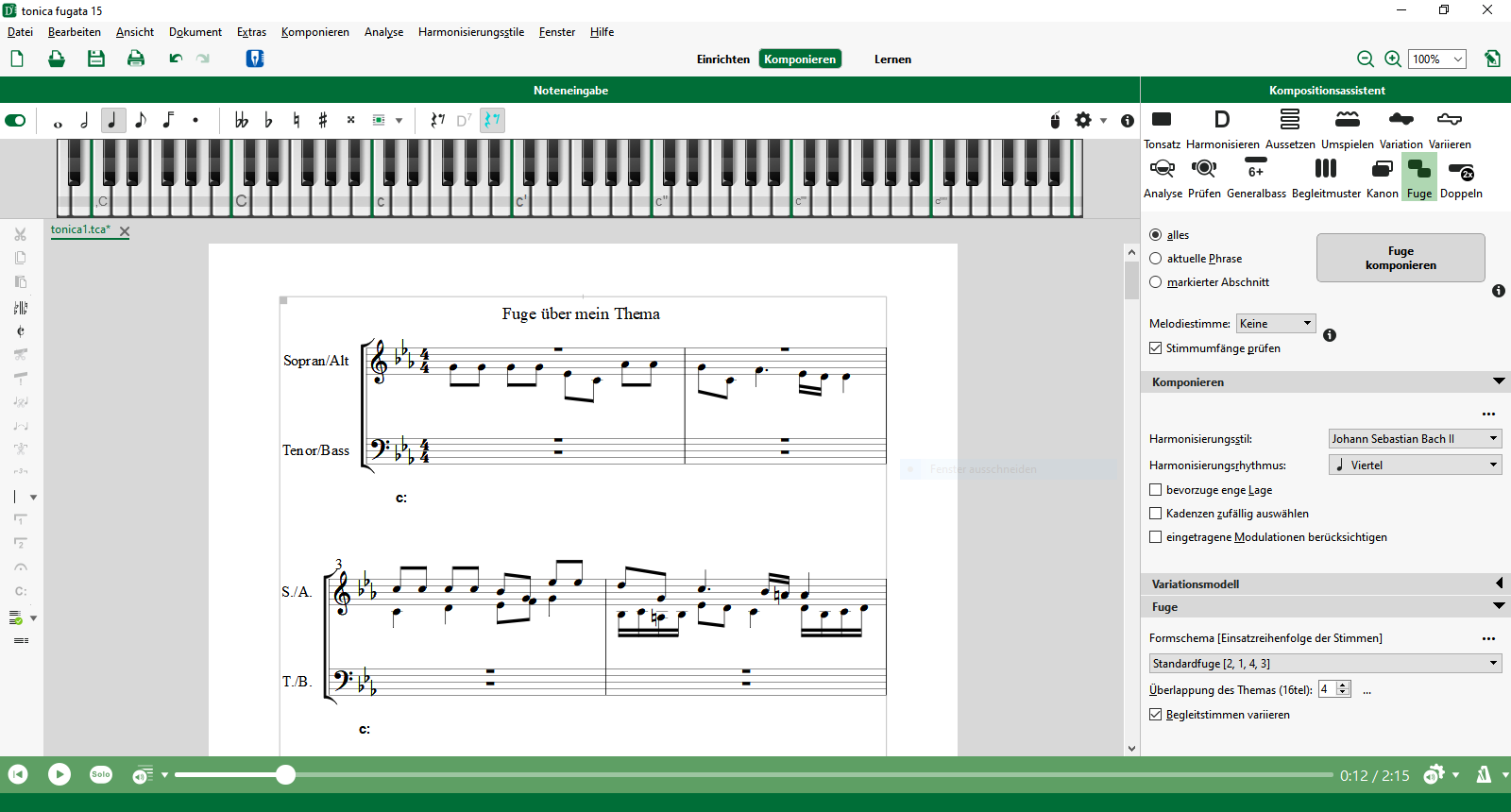
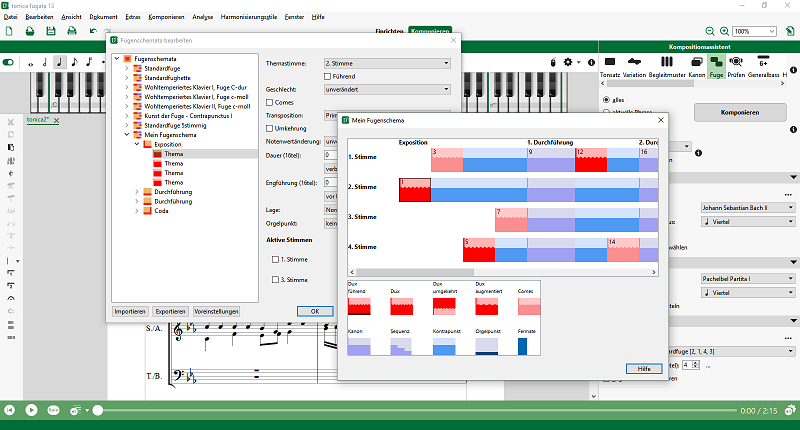
Create the fugue you desire with the fugue construction kit. You can set any form scheme. Ideal for beginners: Via the living connection between notation and fugue construction kit you will see the fugue's architecture in clear graphics - like a house with storeys and rooms.
You compose the melody of a song, hymn, piece of music, canon or fugue. tonica fugata does the rest. [More...]
You compose the melody of a song, hymn or piece of music. The illustration (click to enlarge) demonstrates how this has been done using the "Kum Ba Ya" gospel; in the illustration on the right we have entered the melody of a chorale. Of course you can also compose a prelude, canon, Jazz standard or fugue. Try it out with the demo version!
Step two: tonica fugata does the rest
[Listen]
Harmonies are shown in Roman numeral
By clicking on "harmonize" tonica fugata will compose a four-part harmony in a matter of seconds.
[Listen]
Harmonies are shown in Function theory
Amaze your friends with a three- or four-voice canon! Choose baroque style, romantic style or Jazz style. Canon variations for instrumental groups are no problem at all. [More...]
You see the canon options at the left-hand side and the finished canon at the right-hand side: The melody is in the soprano, the alto enters as reversion, the tenor regularly, and the bass as canon cancrizans. No other software comes near this!
You enter the melody and let tonica fugata create the Jazz harmonies. It's as easy as this! [More...]
At the left-hand side you see tonica fugata's Jazz harmonies. tonica fugata can then vary the composition with riffs etc. (right).
Being a Jazz musician you are not interested in "forbidden" parallels, but you need Sus chords, Maj7 chords and much more. tonica fugata has a complete Jazz engine to allow for specific chords and harmonic changes. Your Jazz compositions will sound authentic.
Evaluating your own compositions is easy: The program has been designed to tell you whether you have added the right notes to the chord in the four-parts, whether you have put the accidentals in the right places and whether you have made forbidden consecutives or other mistakes while composing your chords. If you want to evaluate one of your practice harmonies, all you have to do is create two windows, one containing your work and the other with the file created by tonica fugata - it couldn't be easier! Forbidden parallels are automatically displayed in the notation. Chord analysis is carried out in the evaluation window.
Just imagine, you are faced with a complicated analysis of a piece of musical notation, and you are unsure as to whether a chord is a shortened dominant sept-nonchord or just an extended sub-dominant triad. tonica fugata will take care of all your doubts at the click of a mouse. tonica fugata is also able to analyse exactly complete notations, which contain no function or level indicators, based on a tonal centre. So if you ever wanted to know just what you or others have created, before you proudly present it to an unsuspecting public, or if you ever wanted to sneak a look at the masters, then tonica fugata's analysis function is the ideal tool for you.
[show list of main features...]
| Fugue composition | |
|---|---|
| Fugue composition with numerous variations | |
| Any fugue schema - narrow ranges, reversions, augmentations etc. | |
| Fugue construction kit to create or change fugue schemes | |
| "Living" connection between fugue construction kit and notation | |
| Note entry via PC keyboard, Midi keyboard, mouse piano, mouse cursor | |
| Automatic four-part composition (styles: J.S.Bach, Max Reger, Jazz) | |
| Learning new composition styles using the Style Trainer - create your own style! | |
| Five types of composition variations (prelude function) | |
| Four-voice and three-voice compositions | |
| Canon composition | |
| Canon composition (three and four voices) | |
| Canon composition: Entering voices as reversion, retrograde, canon cancrizans | |
| Canon composition: Entering voices at each interval | |
| Harmonics - composition | |
| Choice of presentation either as functional harmonics (T - D) or interval theory (I-V) or Roman Numeral | |
| Automatic harmonizing | |
| Analysis of harmonics, also in sections | |
| Automatic cadence feature (with over 100 finished cadences by J.S. Bach and Max Reger) | |
| Adding (partial) cadences, modulations; multiple options for the insert function | |
| Comprehensive analysis information on the current cadence | |
| All reversals, septchords and nonchords | |
| Main and auxiliary functions | |
| Intermediary dominants | |
| Composition: Each one of the four voices can be the melody voice. Thus compositions for bass voices (ostinato) are possible! | |
| Composition and variation: The vocal range can be restricted (for certain ensembles) | |
| Dotted harmonization rhythm (important for harmonization in 6/8 time signature) | |
| General | |
| Real modulations (two key levels) | |
| Full integration of Jazz harmonics | |
| Midi import & export and CapXML import and export | |
| Direct interface to capella: View your fugue / your composition in capella with one mouse-click | |
| Real Time Entry and Step Entry of melodies via your Midi keyboard | |
| Import and export functions for new composition styles | |
| Undo and Redo; multiple steps possible | |
| Unrestricted distances between staves and notation systems | |
| Zoom function for monitor | |
| Many options for variation: Variable interaction between voices | |
| Forbidden consecutives are displayed in the notation - also hidden consecutives on request | |
| PDF manual available | |
| Supports the capella-tune technology: Playback with historic or your own tunings | |